 Mechanical Engineering (AI for Materials), Ph.D. Student
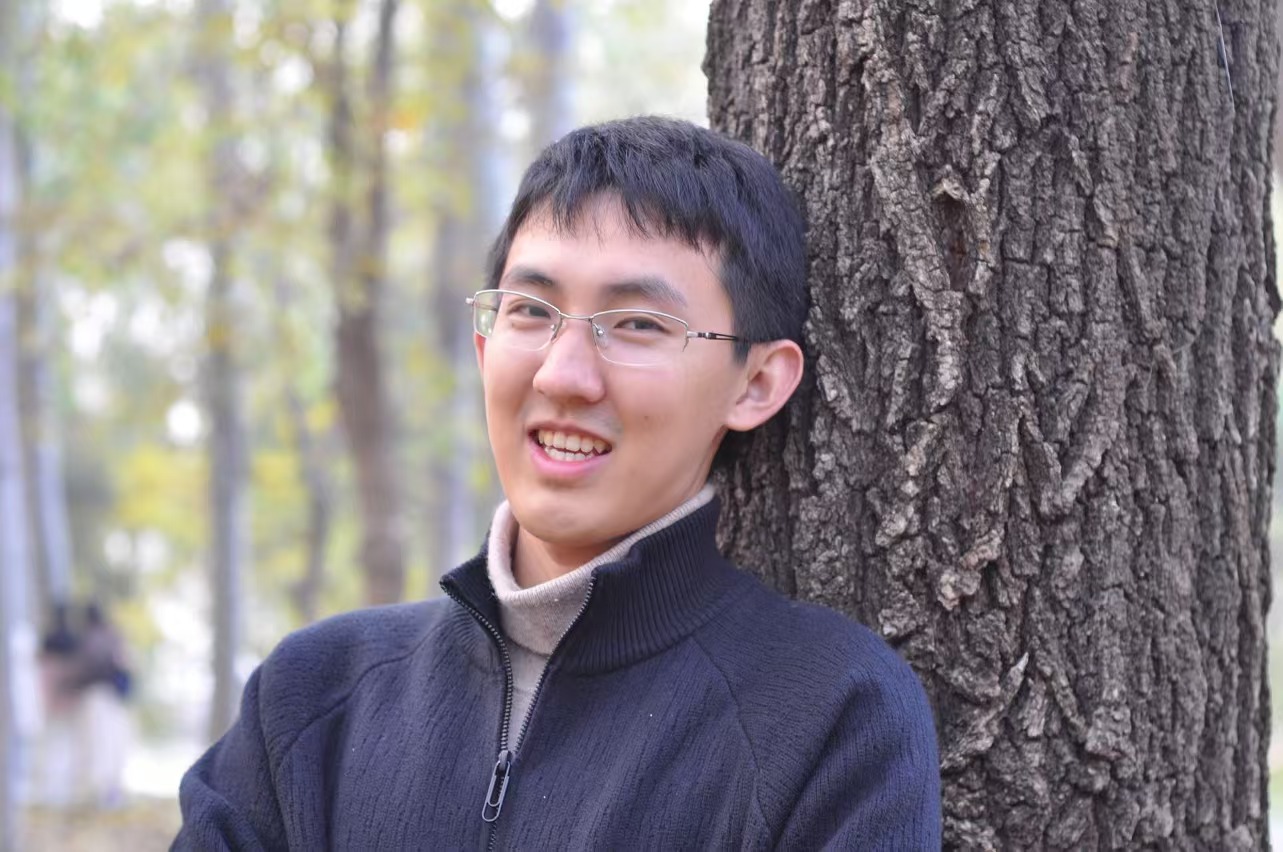
Hello guys, I'm Bo Hu, currently a Ph.D. student at the Department of Mechanical Engineering, The University of Hong Kong (HKU). My research focus on exploring the frontiers of AI-driven materials science research in HKU.
Before joining in HKU, I graduated from Tsinghua University (Mathematics and Physics & Materials Science and Engineering) with Bachelor's Degrees in Natural Science and Engineering. My academic interests lie at the intersection of artifical intelligence and materials science, and I am particularly enthusiastic about leveraging cutting-edge AI technologies to advance scientific discovery.
Outside of academics, I greatly enjoy engaging in conversations and exchanging ideas with others. My hobbies include Sport Stacking, swimming, and traditional Chinese calligraphy. If you're interested in my research or share similar interests, feel free to reach out to me via email—I'd be happy to connect.
Warning
Problem: The current name of your GitHub Pages repository ("Solution: Please consider renaming the repository to "
http://".
However, if the current repository name is intended, you can ignore this message by removing "{% include widgets/debug_repo_name.html %}" in index.html.
Action required
Problem: The current root path of this site is "baseurl ("_config.yml.
Solution: Please set the
baseurl in _config.yml to "Education
-
The University of Hong KongPh.D. Student in Mechanical EngineeringSep. 2025 - August. 2029 (Expected)
-
 Tsinghua UniversityB.S. in Mathematics and Physics & Materials Sciencec and EngineeringSep. 2021 - Jun. 2025
Honors & Awards
-
Hong Kong PhD Fellowship Scheme & HKU Presidential PhD Scholarship2025
-
Excellent Graduates of Tsinghua University (清华大学优良毕业生)2025
-
Comprehensive Excellence Scholarship of Tsinghua University (清华大学综合优秀奖学金)2022, 2023, 2024
-
Academic Excellence Scholarship of Weiyang College, Tsinghua University (清华大学未央书院学业优秀奖学金)2022
-
Social Work Excellence Scholarship of Tsinghua University (清华大学社会工作优秀奖学金)2023
-
Science and Technology Innovaton Excellence Scholarship Of Tsinghua University (清华大学科创优秀奖学金)2024
-
China Undergraduate Mathematical Contest in Modelling - National First Prize (全国大学生数学建模竞赛 全国一等奖)2022
-
Tsinghua University Five-Star Zijing Volunteer (清华大学五星级紫荆志愿者)2023
Selected Publications (view all )
A Multi-agent Framework for Materials Laws Discovery
Bo Hu, Siyu Liu, Beilin Ye, Yun Hao, Tongqi Wen
Preprint at arXiv 2024
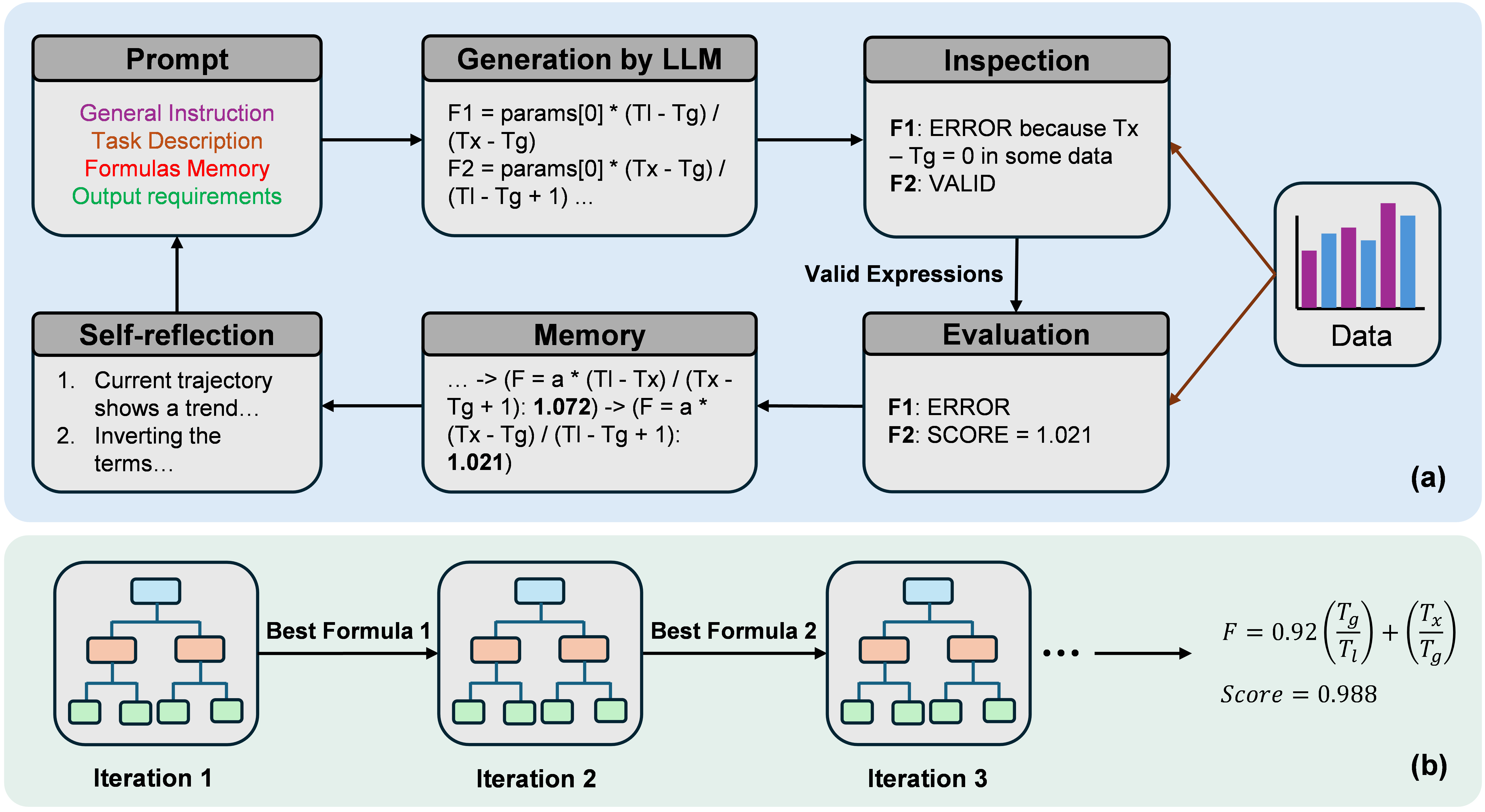
Uncovering the underlying laws governing correlations between different materials properties, and the structure-composition-property relationship, is essential for advancing materials theory and enabling efficient materials design. With recent advances in artificial intelligence (AI), particularly in large language models (LLMs), symbolic regression has emerged as a powerful method for deriving explicit formulas for materials laws. LLMs, with their pre-trained, cross-disciplinary knowledge, present a promising direction in "AI for Materials". In this work, we introduce a multi-agent framework based on LLMs specifically designed for symbolic regression in materials science. We demonstrate the effectiveness of the framework using the glass-forming ability (GFA) of metallic glasses as a case study, employing three characteristic temperatures as independent variables. Our framework derived an interpretable formula to describe GFA, achieving a correlation coefficient of up to 0.948 with low formula complexity. This approach outperforms standard packages such as GPlearn and demonstrates a ~30% improvement over random generation methods, owing to integrated memory and reflection mechanisms. The proposed framework can be extended to discover laws in various materials applications, supporting new materials design and enhancing the interpretation of experimental and simulation data.
A Multi-agent Framework for Materials Laws Discovery
Bo Hu, Siyu Liu, Beilin Ye, Yun Hao, Tongqi Wen
Preprint at arXiv 2024
Uncovering the underlying laws governing correlations between different materials properties, and the structure-composition-property relationship, is essential for advancing materials theory and enabling efficient materials design. With recent advances in artificial intelligence (AI), particularly in large language models (LLMs), symbolic regression has emerged as a powerful method for deriving explicit formulas for materials laws. LLMs, with their pre-trained, cross-disciplinary knowledge, present a promising direction in "AI for Materials". In this work, we introduce a multi-agent framework based on LLMs specifically designed for symbolic regression in materials science. We demonstrate the effectiveness of the framework using the glass-forming ability (GFA) of metallic glasses as a case study, employing three characteristic temperatures as independent variables. Our framework derived an interpretable formula to describe GFA, achieving a correlation coefficient of up to 0.948 with low formula complexity. This approach outperforms standard packages such as GPlearn and demonstrates a ~30% improvement over random generation methods, owing to integrated memory and reflection mechanisms. The proposed framework can be extended to discover laws in various materials applications, supporting new materials design and enhancing the interpretation of experimental and simulation data.